Growing Foreign Direct Investment (FDI) in Middle Tennessee
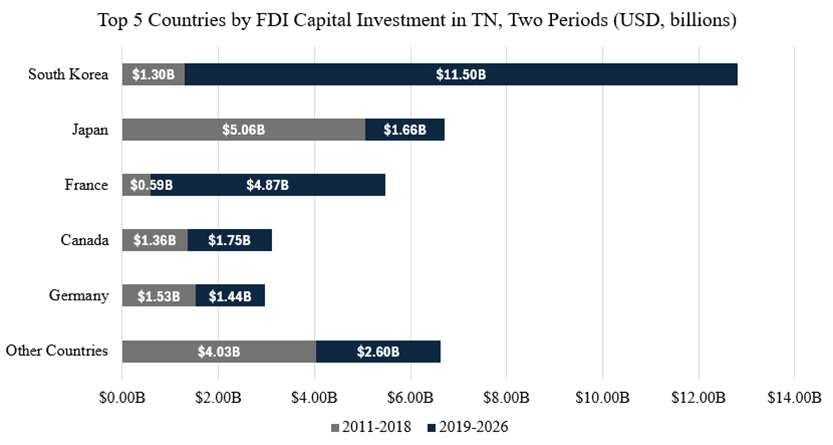
Over the past six years, Korean companies have committed $11.5 billion to Tennessee, accounting for nearly half of all foreign capital the state received during that period. Much of it is flowing into Middle Tennessee, concentrated in batteries and critical minerals. The trend reflects a convergence of federal industrial policy, geopolitical realignment, and co-national clustering.
Source: Author’s compilation and figure; data from Foreign-based Projects in Tennessee (Accessed Feb. 20, 2026)
Industrial Policy, Geopolitics, and the Clustering Effect
Federal policy redirected battery supply chains toward allied nations. The Inflation Reduction Act reshaped where EV and battery supply chains could locate. Enacted in 2022, it pushed production toward North America and allied partners, while Foreign Entity of Concern restrictions excluded inputs from designated non-allied sources. Korean battery makers are well- positioned to meet these requirements: they bring advanced technology, allied-nation status, and qualifying supply-chain pathways.
The rationale has shifted from clean-energy demand to national security. U.S. industrial policy is now anchored in national security, not just clean-energy demand. Even as consumer EV credits ended earlier than expected, manufacturing incentives and restrictions on prohibited entities increasingly favor allied production, including critical minerals. Korea Zinc’s $6.6 billion smelter in Clarksville exemplifies this shift. The facility will process minerals essential to U.S. industry, such as zinc, gallium, and germanium, and the U.S. government is taking a 40 percent equity stake, structuring the project as a national-security partnership rather than a conventional FDI deal.
Co-national clustering reinforces the momentum. Research shows that firms from the same country tend to follow earlier entrants, drawn by established business networks and proven local conditions. This pattern is visible in Middle Tennessee, where successive Korean investments have built on one another. Below are some recent investments:
- Korea Zinc (Clarksville and Gordonsville): $6.6 billion integrated smelter, producing zinc, copper, and critical minerals such as gallium and germanium, creating 740 jobs.
- LG Chem (Clarksville): $3.2 billion cathode plant for EV batteries, creating 860 jobs.
- Ultium Cells (Spring Hill): $2.3 billion LG Energy Solution-GM joint venture upgrading a battery-cell facility for lithium iron phosphate cell production, employing 1,300.
- Hankook Tire (Clarksville): $2.2 billion manufacturing base producing truck and bus radial tires, employing 2,300.
- Additional statewide nodes: BlueOval SK in Stanton (formerly a SK On-Ford joint venture; now run by SK On); Hyosung HICO in Memphis; ALUKO Group in Jackson.
From Momentum to Strategy
For Middle Tennessee, the implication is that the recent surge in Korean FDI is structurally driven–shaped not only by economic fundamentals but also by geopolitical considerations–and reinforced by co-national clustering as firms follow earlier entrants. The region’s challenge is therefore no longer simply attracting investment, but building the capacity to absorb it well. That requires coordinated action: universities building workforce pipelines; business and economic development organizations strengthening aftercare, cross-cultural programming between Korean firms and local workers, and supplier linkages; and state and local governments keeping infrastructure aligned with the pace and scale of investment. Ultimately, clustering depends on an institutional environment that current investors can credibly signal to peer firms back home.

Blog by Dr. Chanyong Yoo, Assistant Professor of International Business at Austin Peay State University