This feature is in our weekly Monday Morning Report newsletter, which showcases our highest-level members. Leaders You Should Know highlights community leaders who are making a notable impact in the Nashville region.
Click here to join our e-newsletter subscriber list.
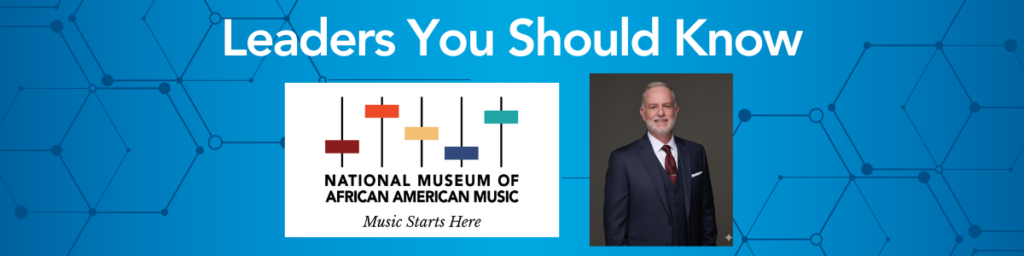
Meet William Jeffries, President of the National Museum of African American Music
Tell us about yourself.
My professional journey spans over three decades of social impact work rooted in community planning, cultural engagement, and equity-driven initiatives. From food access and housing to arts-based programming and exhibitions and international exchanges, I have consistently sought to center marginalized voices and leverage storytelling as a tool for systemic change.
Equity and inclusion are at the core of my work. I prioritize cultural humility, listening sessions, and co-creation with community stakeholders to ensure that any collaborative work reflects true lived experiences. Whether working with public housing residents, artists, multilingual families, or international partners, I have consistently focused on equity by amplifying marginalized voices and dismantling barriers to participation. My approach is grounded in the belief that sustainable change emerges when individuals and communities are not just consulted but empowered as co-authors of their own narratives.
Tell us about your business/industry.
Although trained as a Community Planner, I’ve spent my career in cultural nonprofits and higher education—supporting an orchestra, arts and science center, children’s museum, university, and now a music museum. My planning background has helped each organization better understand and engage its community. Earlier roles included work with a public housing authority, a federal Appalachian agency, and graduate research with interfaith groups in Southeast Baltimore on after school programs and school data.
What should we know about you?
I’m a third generation Air Force veteran, and I remain deeply grateful for that experience. It taught me honor, discipline, and sparked a lifelong passion for travel and culture. I completed basic and technical training in San Antonio, then served in the U.K. as an aeromedical technician, traveling throughout the region and across Europe. I was later selected for special duty in the Gambia, an alternate Space Shuttle landing site. My final assignment in northern Maine allowed me to explore several nearby Canadian provinces.
How did you get to your current position?
I was recruited to NMAAM as Vice President for Development and moved to Nashville in 2022 to take on the role. I was later promoted to Chief Operations Officer, an invaluable year that prepared me for my current position. After a leadership transition, the Board asked me to serve as Interim Executive Director. In March of 2025, I was appointed permanent Executive Director, and by June of 2026, I was appointed as President. It is a profound honor to lead this remarkable museum.
What value do you see in Chamber involvement?
I and NMAAM are deeply grateful for our partnership with the Nashville Chamber. We regularly host Chamber events at the museum, and the Intro to Nashville program was invaluable when I first moved here. I also value Leadership Study Mission which shows how Nashville compares to peer cities—I’ve joined the Tampa, Charlotte, Miami, and look forward to Dallas. These experiences are tremendous opportunities to connect and understand our community on a broader level.
What has been a career highlight for you?
My work consistently advances equitable and sustainable urban policy, power building, and participatory planning through cultural engagement. Over the years, I’ve developed a model positioning museums and cultural organizations as vital components of community ecosystems—scaling nationally and internationally while deepening local roots. From evaluating infrastructure projects at the Appalachian Regional Commission to organizing tenant associations in public housing, I’ve worked to increase community agency in decision-making.
Later roles expanded this approach through arts and education initiatives: STEAM-integrated symphonic programs, digital storytelling projects, and international cultural exchanges in Brazil and Romania funded by the U.S. State Department—all fostering cross-cultural dialogue and participatory learning. Currently, at the National Museum of African American Music, I’m aligning our mission with diverse lived experiences and leading a five-year digital and AI expansion to amplify inclusive storytelling and cultural agency globally.
What makes Nashville a great place to do business?
Nashville is a great place to do business thanks to its fast job and population growth, strong healthcare and tech sectors, business friendly policies, and diverse, resilient economy. Major employers like Amazon, Oracle, and HCA continue to expand, supported by a collaborative environment and no state income tax.
What is the future of AI and new digital technologies in your industry?
AI and digital technologies will deepen access, personalization, and storytelling in museums through immersive experiences, smarter collections management, and broader reach. NMAAM’s five-year expansion will extend our content nationwide and globally with interactive kiosks, a new radio station, and a subscription platform sharing 400 years of history and the voices of over 100,000 African American artists.
What is a hard-earned lesson that you’ve learned?
Throughout my career I’ve often worked as a generalist, which has deepened my admiration for people who devote their lives to mastering a single craft—such as artists, Olympians, and orchestral musicians and conductors. Their discipline and focus create moments of joy and transcendence for audiences, sometimes transforming lives in lasting ways.